
The pendulum swing between IBD flares and the hope for remission can be an intense journey. Dietary strategies can play a powerful role in helping keep symptoms at bay and support remission. With remission, IBD is no longer in the driver’s seat of your life.
Co-written by Renata Cauchon-Robles, MS, RDN
No matter where you are in your journey learning about IBD, searching for the sweet spot in your IBD symptoms, or just getting your head wrapped around a new diagnosis, this blog explores the bright side of ulcerative colitis: remission. Remission is when things can feel a little more normal, when IBD doesn’t dictate your day-to-day.
What is Ulcerative Colitis?
Ulcerative colitis (UC) is one of the main types of Inflammatory Bowel Disease (IBD), along with its close relative Crohn’s Disease. The inflamed ulcers common in UC affect the large intestine, also known as the colon. UC symptoms often bounce between moments of flare-ups and times of remission. We’ll talk about the difference, and how to get your body closer to remission.
What’s the Difference Between a Flare-up and Remission?
UC flare-ups are usually when symptoms are most intense, because the ulcers in the colon are most inflamed. Remission is what we call the times when things feel calmer. This usually means inflammation is decreased and intestinal tissue is stronger.
Just like with diagnosis, some tests can help confirm remission based on how much the intestinal lining has healed after a flare. When the tissues have healed, the risk for IBD complications, like colorectal cancer, tend to decrease. But these tests aren’t always available, or can be extremely uncomfortable. Patients report UC remission being when symptoms are manageable, reduced, or nonexistent.
Now that we’ve reviewed a bit of the background of ulcerative colitis, let’s talk about long-term UC management, treatment, and dietary strategies.
Can UC be Cured?
Many people wonder if you can fully recover from ulcerative colitis. Once you have an IBD diagnosis, continued risk of a flare-up still exists. The good news is that remission is also possible. So, even though UC does not have a cure, long periods of remission can mean minimal or absent symptoms, and an improved quality of life.
Researchers report that histologic remission, where there is healing in the actual tissues that line the large intestine, gives us the best hope for long-term UC remission. Remission is called deep remission or complete remission when both your symptoms are resolved and the intestines are considered healed. If overall inflammation continues, remission can be harder to achieve.
Now we’ll go over some ideas for treatment and dietary management of ulcerative colitis.
Treatment Options for Ulcerative Colitis
Treatment for ulcerative colitis can look different for each person, especially since symptoms and disease severity can vary. While new treatment options continue to be explored, the overall goal of treatment is to reduce inflammation, support intestinal healing, and improve quality of life.
Finding the best treatment approach often depends on your individual symptoms and needs. For example, some people may need support with regaining weight or improving nutrient status after a flare, while others may focus on maintaining remission and preventing future flares.
Medical treatment may include medications (such as anti-inflammatory or immune-modulating therapies) and, in some cases, surgery. Your gastroenterologist can help determine what options are most appropriate for your situation.
It’s also common to wonder whether ulcerative colitis can improve without medication. While there is no cure for UC, some people find that lifestyle and nutrition strategies can play an important role in managing symptoms and supporting remission—especially when used alongside medical care.
Lifestyle factors that may help support long-term management include managing stress, engaging in regular physical activity, and getting enough quality sleep.
The most effective approach is often a combination of nutrition strategies, medical treatment, and lifestyle habits. Working with your healthcare team—including your gastroenterologist and IBD dietitian—can help you create a plan that feels sustainable and supportive for your long-term health.
UC Remission Without Medication
With chronic disease like IBD, it’s common to be concerned about whether you have to take medication for life with ulcerative colitis. While medications can help with inflammatory responses, or intestinal activity, there isn’t a general medication available to help cure ulcerative colitis. Some people do find medication helpful to keep remission under control. This is especially true if symptoms are more moderate or severe to begin with.
Lifestyle factors like nutrition, stress management, physical activity, and sleep can also support long-term symptom management.
The best plan is to talk with your gastroenterologist, dietitian, and healthcare team to find a combination that works for you. Oftentimes, what can get you feeling better is a combo of nutrition strategies, medication, and lifestyle activities.
Let’s take a closer look at digestion and how it relates to ulcerative colitis.
Deep Dive: Ulcerative Colitis Remission Diet
Nutrition and diet can help with managing IBD symptoms and overall gut health. As part of the whole digestion process, our intestines are where the majority of nutrients are absorbed from our food after it gets broken down. The large intestine, or colon, also helps control hydration and electrolyte balance in the body.
With ulcerative colitis, that typical process gets interrupted. The colon is inflamed, appetite can decrease, and diarrhea can increase too. This can interrupt the body’s ability to absorb and transport nutrients to the rest of the body; and also affects hydration status. Zooming out, this is why UC symptoms or complications can arise outside of the digestive system, too, such as decreased bone density, anemia, or other skin, eye, and joint issues.
With this in mind, focusing on what nutrients you get from your diet can help fill the gap. With more nutrients available from your diet, your body has a better chance of healing and staying strong.
Next, we have some strategies for managing your overall diet, and some great recipes from our team!
4 Diet Strategies for Ulcerative Colitis
During an IBD flare, the digestive system is on high alert and can be overly reactive to certain foods and textures. Finding what your body can tolerate is very important. What works for you might not work for the next person you meet with IBD.
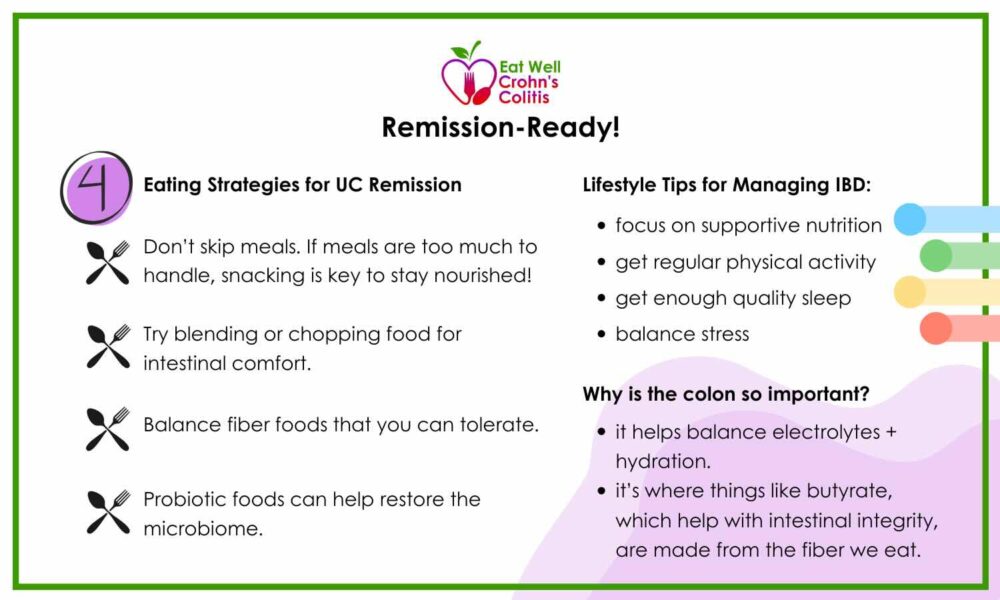
Our hope is that the following 4 food strategies can help you get closer to remission:
- BITE-BY-BITE: Try not to skip meals. While your intestines may need a rest, even a small snack can help ensure you get the nutrients you need.
- SOFT & SMALL: Try blending or chopping your food a little extra to improve intestinal comfort.
- FIBER DAZE: Balance your fiber intake with foods that you can tolerate. Different people can handle different types of fiber, it depends on your symptoms and individual health history.
- BACTERIA BUDDIES: Consider probiotic foods like yogurt or miso for restoring the ‘good bacteria’ in your microbiome.
Talk with your healthcare team to confirm what approaches might be best for you.
Dietitian-approved Recipes for People with UC:
In general, including a protein source with each meal or snack can help intestinal tissues heal.
- Try these Almond Flour Chocolate Zucchini Muffins as a simple breakfast or snack item,
- A colorful Carrot & Fennel Soup for lunch,
- Or this Cilantro Lime Rice side dish!
Take Home Message
Ulcerative colitis remission is when symptoms are dormant or healed to a point where IBD is not dictating your day-to-day. Periods of remission can be followed by occasional flares. Balancing protein, fiber, probiotic foods, and other eating habits can help you achieve remission.
Learn More
- Explore a new future with this 12-week Remission Program
- Learn about different types of fiber.
References
- Roman-Green, B. Inflammatory Bowel Disease: Crohn’s Disease and Ulcerative Colitis. Nutrition Care Manual. 2022.
- Iacucci M, Jeffery L, Acharjee A, et al. Ultra-high Magnification Endocytoscopy and Molecular Markers for Defining Endoscopic and Histologic Remission in Ulcerative Colitis—An Exploratory Study to Define Deep Remission. Inflamm Bowel Dis. 2021;27(11):1719-1730. doi:10.1093/ibd/izab059
- Kayal M, Posner H, Spencer E, et al. Net Remission Rates with Biologic and Small Molecule Treatment in Ulcerative Colitis: A Reappraisal of the Clinical Trial Data. Clinical Gastroenterology and Hepatology, Volume 21, Issue 13, 3433 – 3436.e1
- Wood DW, Treiman K, Rivell A, et al. Communicating Information Regarding IBD Remission to Patients: Evidence From a Survey of Adult Patients in the United States. Inflamm Bowel Dis. 2025;31(6):1605. doi:10.1093/ibd/izae201
- Crohn’s & Colitis Foundation. Ulcerative Colitis Treatment Options. 2026. Accessed March 16 2026. https://www.crohnscolitisfoundation.org/patientsandcaregivers/what-is-ulcerative- colitis/treatment-options
- CDC. Inflammatory Bowel Disease (IBD) Basics. Published June 21 2024. Accessed March 16 2026. https://www.cdc.gov/inflammatory-bowel-disease/about/index.html#cdc_disease_ basics_compli-complications
- Stanford Medicine. Inflammatory Bowel Disease (IBD) Program | Stanford Health Care. https://stanfordhealthcare.org/medical-clinics/inflammatory-bowel-disease-ibd-program.html?
- Imbrizi M, Magro F, Coy CSR. Pharmacological Therapy in Inflammatory Bowel Diseases: A Narrative Review of the Past 90 Years. Pharmaceuticals (Basel). 2023;16(9):1272. Published 2023 Sep 8. doi:10.3390/ph16091272