
IBD symptoms often come with an ebb and flow, and lots of gray areas as things develop. We wanted to help you answer the question, how is Crohn’s disease diagnosed?
Co-written by Renata Cauchon-Robles, MS, RDN
As rates of Crohn’s disease increase worldwide, symptom screening and diagnostic tools continue to evolve to keep up.. If you’ve received a diagnosis of Crohn’s disease, or are wondering if you will soon, your symptoms and medical history are likely part of the story. Read on as we explore how Crohn’s disease is diagnosed, common medical tests, and current research on the topic.
How is Crohn’s Disease Diagnosed in Adults?
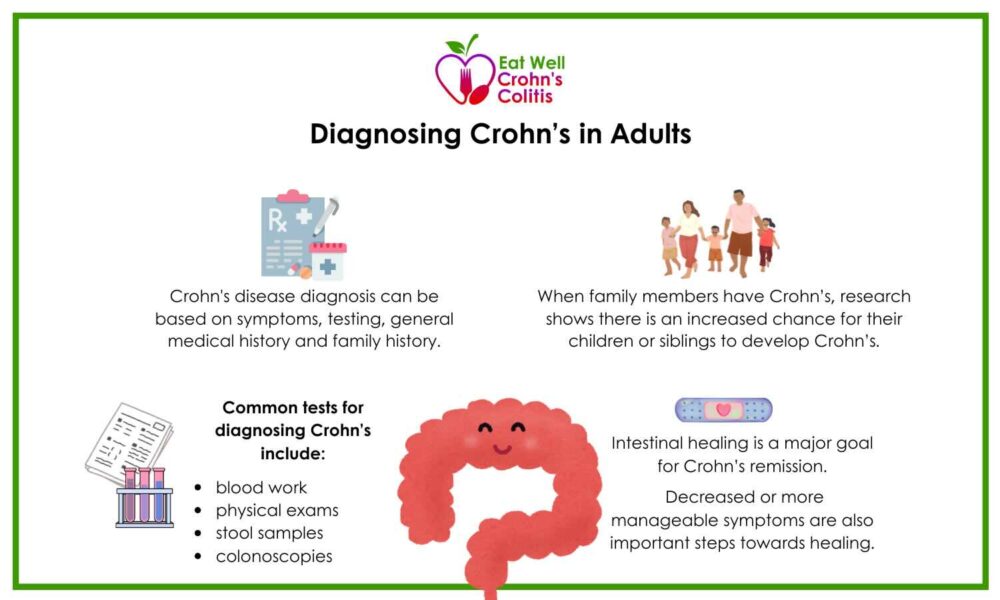
In adults, a Crohn’s disease diagnosis can be based on symptoms, testing, general medical history and family history. Before testing, symptoms like diarrhea, bloody stools, cramping, or weight changes can give your healthcare team important clues about whether Crohn’s disease may be present.
This blog will mostly talk about Crohn’s disease diagnosed in adults. If you want to learn more about pediatric crohn’s, you can check out this article.
How is Crohn’s Disease Tested?
Different tests are available to confirm a diagnosis of Crohn’s disease or to test how severe it has become. Practice can vary country to country, but here are some of the most common Crohn’s disease diagnostic tests:
- Blood work can help check for anemia, which can be common if you are having bloody stools, having issues absorbing nutrients, or not eating as much as you used to. Blood tests can also check for C-reactive protein, a well-known clue for inflammation.
- Physical exams can screen for intestinal inflammation, blockages, or clues that the symptoms may be related to something else.
- Stool samples are very common. The stool is then tested for clues related to inflammation, infection, and microbiome health.
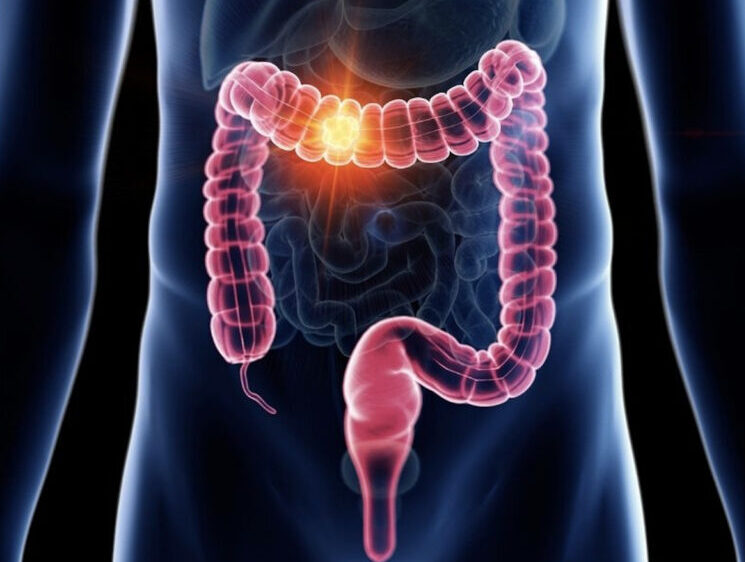
- A colonoscopy for Crohn’s disease is another strategy. Related procedures like colonoscopies, endoscopies, or enteroscopies are used to get a picture or video of the intestines. These can also be used to collect a biopsy to directly test the intestinal mucosa lining.
These are some of the most commonly used tools for diagnosing Crohn’s disease. New research is still happening so that medical teams can know more and help more.
Up and Coming Crohn’s Research
Tissue testing is mostly used by researchers to test if IBD treatments work, because intestinal healing is considered an important indicator of Crohn’s remission. That said, researchers are trying to simplify intestinal tissue tests, so they can be more available to patients receiving clinical care for IBD.
Did you know saliva can also give clues into Crohn’s disease inflammation?
A main difference from ulcerative colitis is that Crohn’s disease can cause inflammation anywhere from the anus to the mouth, which is considered the full path of the gastrointestinal tract. Using saliva to test for the microbiome is something that researchers have started using to understand many inflammatory diseases like Crohn’s.
IBD research has compared the different bacteria found in the saliva, intestines, and stools of people with Crohn’s disease to gain more understanding around where inflammation is active, and how Crohn’s disease is related to the overall microbiome. The idea is that saliva is much easier to get a sample of, compared to collecting stool samples or intestinal tissue, which can make diagnosing Crohn’s disease much easier for patients and providers.
Now we’ll talk about the timing of getting a Crohn’s diagnosis and potential Crohn’s risk factors.
Can You Suddenly Develop Crohn’s Disease?
Crohn’s is considered a complex condition, and research is still fairly new in understanding why and how it develops. When someone is diagnosed under the age of 17 it’s called early-onset Crohn’s disease or pediatric Crohn’s. This makes up less than 20% of the diagnoses worldwide. Similarly, it’s called late-onset Crohn’s when someone is diagnosed over the age of 60. This accounts for about 10-15% of known cases of Crohn’s disease. Both are increasing, along with increased diagnosis of Crohn’s overall, especially in Western society.
Research has found that the timing of diagnosis does make a difference. When diagnosed earlier in life, the disease can be more aggressive or intense. At the same time, symptoms can be difficult to identify, which can lead to what’s called a delayed diagnosis. Some reasons why a diagnosis can be delayed might be because:
- symptoms are ignored,
- people don’t notice irregular bowel movements,
- people with symptoms find it uncomfortable to talk about,
- language barriers or pressures of daily life get in the way of communicating with a medical provider.
Lots of people wonder how a family history of Crohn’s or IBD might be related.
Is Crohn’s Hereditary?
Crohn’s is not linked to one specific gene, like some other genetic diseases, but it does appear to have a genetic connection. When family members have Crohn’s, research shows there is an increased chance for their children or siblings to develop Crohn’s. There is ongoing genetics research to see if there are specific gene mutations linked with Crohn’s disease specifically, IBD in general, and inflammation overall.
What we know is that some genes are especially important in building the structural integrity of cells, such as the endoplasmic reticulum and extracellular matrix. If a group of cells in the intestines are struggling to develop these important building blocks, the intestinal walls may be weaker, and we know weakness in the intestines is a key aspect of IBD and Crohn’s disease.
What to do After Diagnosis
Most importantly, your specific symptoms matter and are a huge part of deciding next steps. For example, if you’re experiencing constipation, mouth sores, or eye-related symptoms. If you are already working with a healthcare team who let you know about your diagnosis, continue following their recommendations.
For more severe cases, it may be time to consider medication or surgery. And for everyone, healthy lifestyle habits—including nutrition, stress management, physical activity, and sleep—can make a meaningful difference.
People who live well with Crohn’s disease often do so through ongoing management. This can look like keeping up with follow-up visits, monitoring symptoms or changes, and adjusting treatment as needed. Dietitians, gastroenterologists, doctors, and other members of a healthcare team are helpful partners to guide you along the way. Working with a registered dietitian who specializes in IBD can help you personalize your nutrition approach, support symptom management, and maintain adequate nutrient intake. Your care team can also help you sort through changing or confusing symptoms. We invite you to start here.
Take Home Message
Getting a diagnosis of Crohn’s disease can be a difficult thing to hear, and sometimes even harder to confirm. Your healthcare team will ask you about your personal history, including how your bowel movements typically are, your family history, and any current symptoms you might be having. It’s all part of the story to know how to best take care of you. What’s most important is not ignoring your symptoms—because with the right support and guidance, you can take this one step at a time and find what works best for you.
Learn More
- Wondering how to match your Crohn’s diet with your bulking up plans? Read more here.
- Learn about how salad and Crohn’s disease can get along.
References
- Saigusa N, Hotta N, Saigusa J. Diagnostic Process and Applied Criteria for Crohn’s Disease in Patients Presenting with Perianal Lesions in Japan: A Retrospective Observational Multicenter Cohort Study. Inflamm Int Dis. 2025;10(1):76+. doi: 10.1159/000545081
- National Institute of Health; Diabetes and Digestive and Kidney Diseases. Diagnosis of Crohn’s Disease. Reviewed July 2024. Accessed April 2026. https://www.niddk.nih.gov/health- information/digestive-diseases/crohns-disease/diagnosis
- Adler J, Eder SJ, Gebremariam A, et al. Development and Testing of a New Simplified Endoscopic Mucosal Assessment for Crohn’s Disease: The SEMA-CD. Inflamm Bowel Dis. 2021;27(10):1585-1592. doi:0.1093/ibd/izaa307
- Seung YS, Kim S, Choi JW, et al. The Common and Unique Pattern of Microbiome Profiles among Saliva, Tissue, and Stool Samples in Patients with Crohn’s Disease. Microorganisms. 2022;10(7):1467. doi:10.3390/microorganisms10071467
- Cantoro L, Lenti MV, Monterubbianesi R, et al. Early-onset versus late-onset Crohn’s disease: An Italian cohort study. United European Gastroenterology Journal. 2020;8(1):52-58. doi:10.1177/2050640619860661
- Rizzello F, Spisni E, Giovanardi E, Imbesi V, Salice M, Alvisi P, Valerii MC, Gionchetti P. Implications of the Westernized Diet in the Onset and Progression of IBD. Nutrients. 2019; 11(5):1033. doi:10.3390/nu11051033
- Sazonovs A, Stevens CR, Venkataraman GR, et al. Large-scale sequencing identifies multiple genes and rare variants associated with Crohn’s disease susceptibility. Nat Genet. 2022;54(9):1275-3,1283A-1283J. doi:10.1038/s41588-022-01156-2