
Learning how to manage Crohn’s disease in children can feel overwhelming at times, but a combination of dietary strategies and/or medications can help support remission and reduce inflammation over time.
Co-written by Renata Cauchon-Robles, MS, RDN
This blog post is a deep dive into understanding Crohn’s disease in children. We talk medication, diet, and lifestyle management because we know it’s a big mountain to climb. We know it can feel like a big mountain to climb, so we’ve included helpful details, useful questions, and key tips based on updated research about pediatric Crohn’s disease.
Are you born with Crohn’s disease?
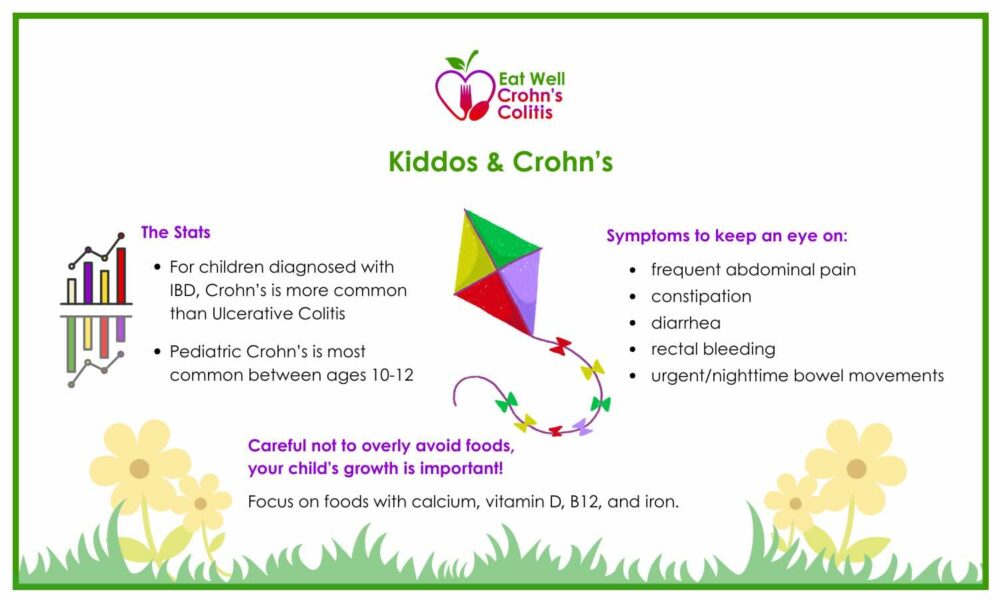
First off, you might be wondering if Crohn’s can be a common disease in early childhood. In general, about 25% of people with IBD first got IBD as a child (this is called pediatric-onset IBD). The typical age when kids get diagnosed with Crohn’s disease is around 10-12 years old, but “very early onset” IBD can start even before children turn 6 years old. Within this group of young IBD warriors, Crohn’s is more common than Ulcerative Colitis. Just like IBD in adults, it is more common in the United States than other countries around the world.
It’s not totally known what causes Crohn’s in early childhood, because it can be related to a mix of genetic and environmental factors.
How do I know if my child has Crohn’s disease?
Crohn’s disease in children can sometimes present differently than in adults and may involve a wider range of symptoms.
Some symptoms we recommend you pay attention to if you are wondering if your child has Crohn’s disease are frequent abdominal pain, constipation, diarrhea, rectal bleeding, urgent or nighttime bowel movements. Some of these can be subtle, or gradually intensify. Secondary symptoms like weight loss, joint pain, iron-deficiency anemia, undernutrition or mouth sores can also be clues.
The symptoms listed above are usually caused by how Crohn’s decreases regular nutrient absorption, changes eating habits, and increases the inflammatory responses in the body. Because of this, late puberty or delayed growth patterns are some of the common signs of Crohn’s disease in children, too.
Now that we know a little about what early stages of Crohn’s disease can look like, let’s talk about how pediatric Crohn’s is diagnosed.
How is pediatric Crohn’s disease diagnosed?
Diagnosing pediatric Crohn’s can take time, but pay attention to some of the symptoms listed above so your doctor can have a full picture. A physical exam, including abdominal and rectal exams are often part of the doctor’s process. Lab tests can also be helpful to see if there are any electrolyte deficiencies, to confirm inflammation, and for performing stool bacteria tests. Once there is a suspicion of Crohn’s from these different tests, a colonoscopy is common to officially diagnose pediatric Crohn’s disease.
The diagnostic process can involve several steps, which may feel like a lot, but each one helps your child’s care team better understand what’s going on.
Next, we will talk about some different treatment options and things to consider when children have Crohn’s disease.
How is Crohn’s disease treated in children?
The goal of treating Crohn’s disease is to support the body in reaching IBD-remission. It’s also important to help the mucosal lining of the intestines heal well. Pediatric IBD has less approved treatment options, currently, but research is always learning!
Ultimately, what type of treatment or combination of treatments that is right for your child will depend on many things. There is lots to consider, and your child’s quality of life is also very important. Here are some questions you can keep in mind when you talk with your pediatrician and/or dietitian to understand what to do next:
- How severe has Crohn’s disease progressed for your child?
- What area of the body is Crohn’s affecting them the most?
- What is the current status of your child’s growth patterns?
Below, we have a short list of some medication approaches that are common for Crohn’s disease in children.
Medication options
- Corticosteroids or other medications that target the immune system have been used as a common treatment for Crohn’s disease over the years. While they can be effective for reducing inflammation, they may also come with potential side effects, such as an increased risk of infection, impacts on bone health, or changes in growth patterns–especially with longer-term use. This is why close monitoring by your child’s healthcare team is so important.
- Therapies such as anti-TNF therapy have shown to help block the inflammation caused by Crohn’s disease and also improve childhood growth patterns. (TNF stands for Tumor Necrosis Factor, a type of protein that triggers the inflammation in different autoimmune conditions like Crohn’s). This method on its own or in combination has shown to be most helpful in more advanced Crohn’s or when treatment can start early.
- Antibiotics can be used to try and regulate the microbial environment in the gut or to treat other openings in the intestinal tissue. This has to be done carefully, or temporarily, to not overcorrect for the healthy bacteria that we want to keep.
We shared a bit about medication approaches, but as a dietitian I definitely want to share with you some food-related solutions!
What should a child with Crohn’s disease eat?
In some cases, especially in mild to moderate pediatric Crohn’s disease, nutrition therapy (such as enteral nutrition or structured therapeutic diets like the Crohn’s Disease Exclusion Diet) may be used as a first-line approach to help reduce inflammation and support remission, under the guidance of a healthcare team.
Tackling Crohn’s with dietary changes is also a great way to support overall treatment. Nutrition and medication can work hand in hand, depending on your child’s symptoms. The goal is to reduce inflammation and support a healthy gut environment.
What kids eat can be a huge help for positive long term health outcomes and healing. Ongoing research is showing that a combo dietary treatment of tube feeding (aka enteral feeding) plus the Crohn’s Disease Exclusion Diet can help encourage remission in as short as 6 weeks. The Crohn’s exclusion diet is specifically designed to be anti-inflammatory. Other people have found success in the low FODMAP diet, or specific carbohydrate diet, but it depends on your individual case, what feels doable, and what other treatments are being tried.
Here are some general things to consider about a pediatric Crohn’s-friendly diet:
- Crohn’s disease can make it harder for the intestines to digest nutrients. This can be from inflammation or damage to the intestinal lining, so vitamins might not get absorbed like we want. Focus on foods with calcium, vitamin D, B12, and iron.
- With inflammation, it’s common for appetite to decrease. This can be even more true with uncomfortable GI symptoms like nausea, diarrhea, or pain.
- Getting quality protein foods from plant or animal sources can help encourage healing of tissue that can be damaged from Crohn’s disease.
- One food that causes digestive issues might not mean you have to avoid it completely, but definitely try to offer it less often.
- Restricting too many foods can sometimes make it harder for children to meet their nutrition needs and support growth. So it’s important to choose carefully about what foods to avoid.
Overall, both medication and dietary changes can make day to day life a little tricky, so definitely talk with a dietitian and pediatrician to decide what makes the most sense for managing Crohn’s in your family. Together they can help make sure your child gets enough energy and nutrients from food, and grows strong bones to support them in life.
Keep reading for a little more information about how Crohn’s relates to child growth patterns.
Does Crohn’s disease impact my child’s growth?
For growing children, intestinal inflammation does have some link with delayed growth and puberty, with some link with potential impacts on bone health and emotional well-being, too. These can sometimes be the first symptoms that we notice while arriving at a diagnosis of Crohn’s disease in children.
Good news though, research and pediatric medicine has shown that growth issues improve when the mucosal lining of the intestines are healed.
Let’s now take a look at a couple individual stories to help understand how Crohn’s can show up for kids, with some ideas of how to help them get better:
Here are two real-life examples from my work as a dietitian that show how Crohn’s can present differently in children. The following case studies are based on real clinical experiences from my work as a dietitian. Names and identifying details have been changed to protect patient privacy.
Case Study 1: Early Signs in a Young Child (Very Early Onset Crohn’s)
Meet Liam, age 4
When I began working with Liam and his family, his parents were concerned that he wasn’t growing as expected. They noticed he hadn’t outgrown his clothes as expected over the past year, and his weight gain had slowed. He also had frequent stomach aches, loose stools, and a decreased appetite, though he had difficulty clearly describing his symptoms due to his age.
After evaluation by a pediatric gastroenterologist, Liam was diagnosed with Crohn’s disease affecting his small intestine–classified as very early onset IBD.
What stood out:
- Slowed growth and weight gain
- Frequent abdominal discomfort (“tummy hurts”)
- Loose stools
- Decreased appetite
Treatment approach:
- Medication to reduce inflammation
- Pediatric formula for nutrition support
- A structured dietary approach (e.g., Crohn’s Disease Exclusion Diet), adapted for his age
Nutrition focus (my role as the dietitian):
- Supporting catch-up growth with adequate calories, protein, and key nutrients (iron, calcium, vitamin D, B12)
- Helping the family implement small, frequent meals
- Guiding food choices that were simple, familiar, and well-tolerated
Outcome:
With a combination of medical treatment and nutrition support, Liam’s symptoms improved. His energy increased, his appetite gradually returned, and his growth began trending in a healthier direction.
Key takeaway:
In young children, Crohn’s may show up as slowed growth and appetite changes rather than clear GI complaints—making growth patterns an important early clue.
Case Study 2: Managing Symptoms and Fear of Food During a Flare
Meet Sofia, age 14
I worked with Sofia after she began experiencing a flare following a period of stability with her Crohn’s disease. She reported abdominal pain, urgency, and frequent bathroom trips–especially during school. Over time, she started avoiding food out of fear that it would worsen her symptoms.
What stood out:
- Increased symptoms (pain, urgency, diarrhea)
- Fear of eating due to symptom triggers
- Reduced intake and mild weight loss
- Stress around managing symptoms at school
Treatment approach:
- Adjustment of her medication regimen
- Ongoing nutrition support
- Gradual reintroduction of foods as symptoms improved
Nutrition focus (my role as the dietitian):
- Identifying easier-to-digest foods during the flare
- Supporting hydration and adequate intake
- Helping her include calorie-dense, well-tolerated foods
- Rebuilding confidence around eating and reducing food fear
Outcome:
As inflammation improved, Sofia was able to expand her diet, feel more comfortable eating, and return to her usual routine with fewer disruptions.
Key takeaway:
During flares, kids and teens may develop fear around food. A supportive, individualized nutrition approach can help manage symptoms while protecting growth, nutrition, and quality of life.
Take Home Message
If you’re taking care of a child with Crohn’s disease or complicated GI symptoms, it’s important to focus on anti-inflammatory foods while supporting your child’s overall quality of life. This might mean a combination of medication and diet approaches to help the child get the nutrients they need, support the growth of strong bones, reduce hospitalization frequency and control the overall course of the disease. A custom approach is what tends to work best, so there isn’t one perfect way.
Learn More
- Learn about ways to boost iron absorption naturally with foods.
- Take a look at a sample 7-day meal plan for IBD.
- Explore these 5 self-care strategies to help your child learn IBD self-care that they can carry throughout their life.
References
- Mitchel EB, Rosh JR. Pediatric Management of Crohn’s Disease. Gastroenterol Clin North Am. 2022 Jun;51(2):401-424. doi: 10.1016/j.gtc.2021.12.013.
- Baldwin K, Grossi V, Hyams JS. Managing pediatric Crohn’s disease: recent insights. Expert Rev Gastroenterol Hepatol. 2023 Jul-Dec;17(10):949-958. doi: 10.1080/17474124.2023.2267431.
- Gkikas K, Svolos V, White B, Gerasimidis K. An update on dietary therapies in paediatric Crohn’s disease. Curr Opin Clin Nutr Metab Care. 2024 May 1;27(3):304-312. doi: 10.1097/MCO.0000000000001024.
- Scarallo L, Lionetti P. Dietary Management in Pediatric Patients with Crohn’s Disease. Nutrients. 2021;13(5):1611. 2021 May 11. doi:10.3390/nu13051611